


 Long live Ukraine! Fuck the war!
 RSS of site articles
Anyone who has studied contemporary history will already know, from their secondary school days, about the industrialisation of the USSR in the Stalin era. A real swot might even remember the two «waves» of industrialisation: the first in the 1930s and the second in the post-war period. The first wave was driven by industrial espionage and the massive purchase of foreign machinery. The second, by contrast, was the result of reparations not authorised by the Allies (that is to say, international plunder).
Thus, for example, Soviet technicians dismantled entire factories in Germany and reassembled them in the USSR. Formally, this behaviour was justified by the measures adopted by the victors of the Second World War against factories that had collaborated with the Wehrmacht. The DKW motorcycle factory, for instance, was transferred from the town of Zschopau to four Soviet cities (Moscow, Minsk, Izhevsk and Serpukhov) in order to modernise local plants.
The Minsk factory (in Belarus) received the machinery in the second half of December 1945 and initially used it for bicycle production. Only in 1951 did production begin of the M1A motorcycle with a displacement of 125 cc and 4.25 hp (a copy of the German DKW RT125).

Although it was the third most popular motorcycle brand in the USSR, «Motovelo» (the Minsk factory) was likewise unable to offer the public a wide range of models. Until 1991, only one model at a time was produced. Each model was, in reality, a slightly modernised version of its predecessor. In essence, for forty years the DKW RT125 continued to be produced (the same, as I have already written, happened with Izh motorcycles). The appearance changed little, the engine output even less. Over forty years, however, horsepower rose from 4.25 to 11.5, while top speed increased from 70 to 98 km/h.
I shall mention only the most successful versions, those most commonly used by Soviet youth as light motorcycles.
The single-seat M103 was produced from 1962 to 1964. It had three gears, a 5 hp engine, and a top speed of 75 km/h.
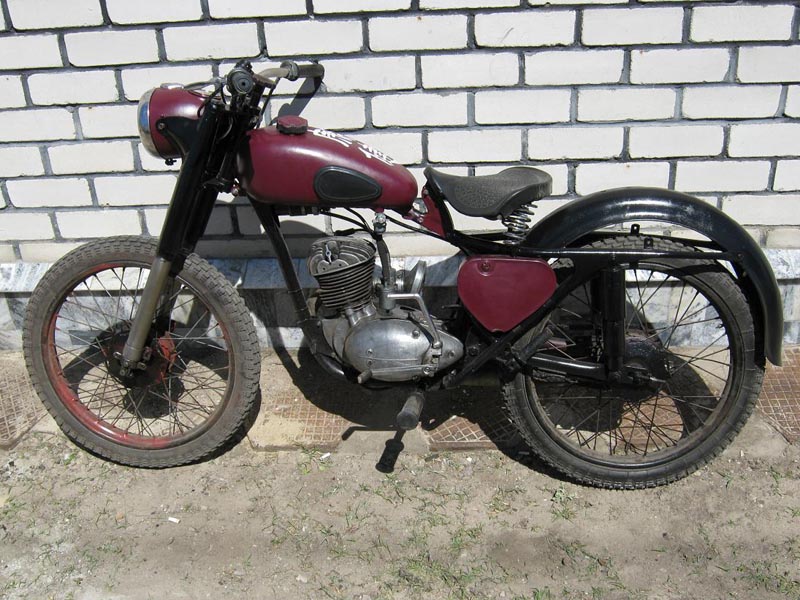
The M104, produced from 1964 to 1967, had two seats and, for that reason, the popularity of the marque rose sharply. The engine was uprated to 5.5 hp.
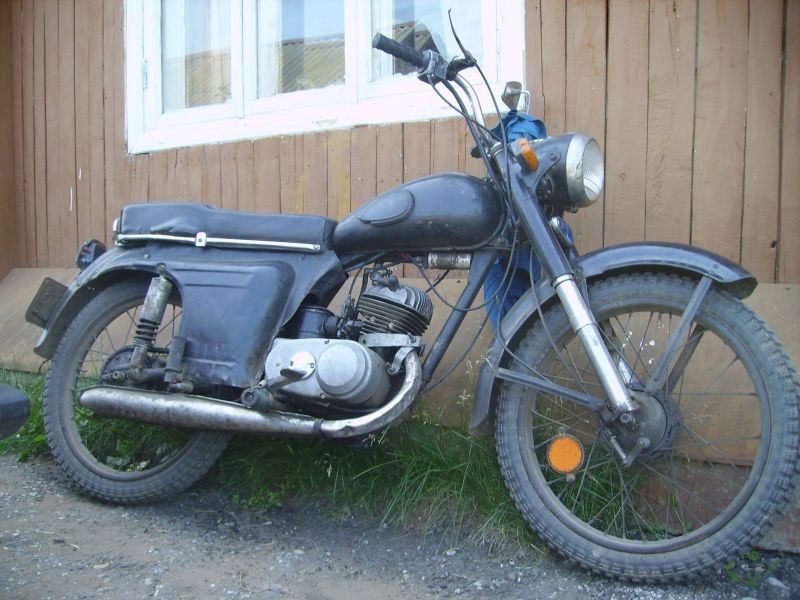
On the M106, a luggage rack was fitted for the first time—another highly appreciated detail. This motorcycle was produced from 1971 to 1973; it had four gears, 9 hp, and a top speed of 85 km/h.
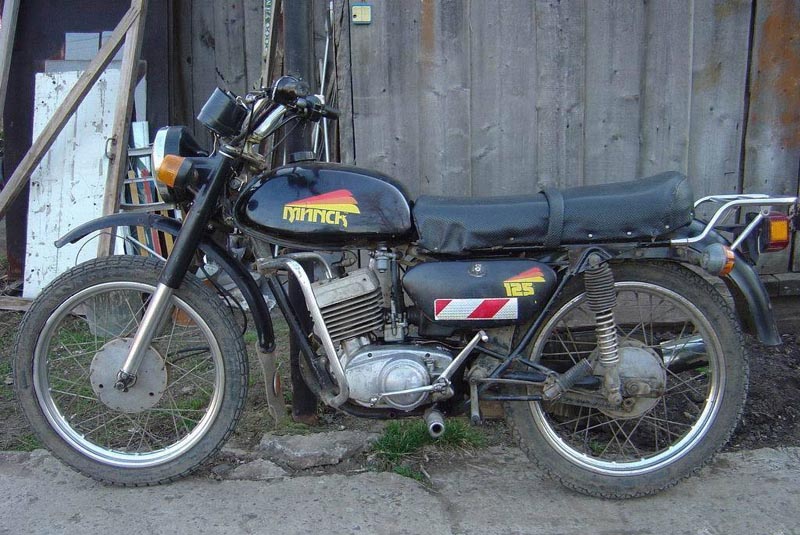
In 1974, a modest restyling made the motorcycle somewhat more modern in appearance. Engine improvements, however, continued to progress slowly. After two «transitional» models, this new series was designated M-3.112 and established itself on the market. Its external appearance remained unchanged from 1974 to 1991—for more than seventeen years.

The 1990s were disastrous for the economy of newly independent Belarus. Consequently, very few motorcycles were produced (still of the M-3.112 series). The factory resumed activity only in the 2000s. And at that point, things became interesting. For suddenly the local engineers learned to imitate modern motorcycles, making a leap from the 1940s into the twenty-first century.
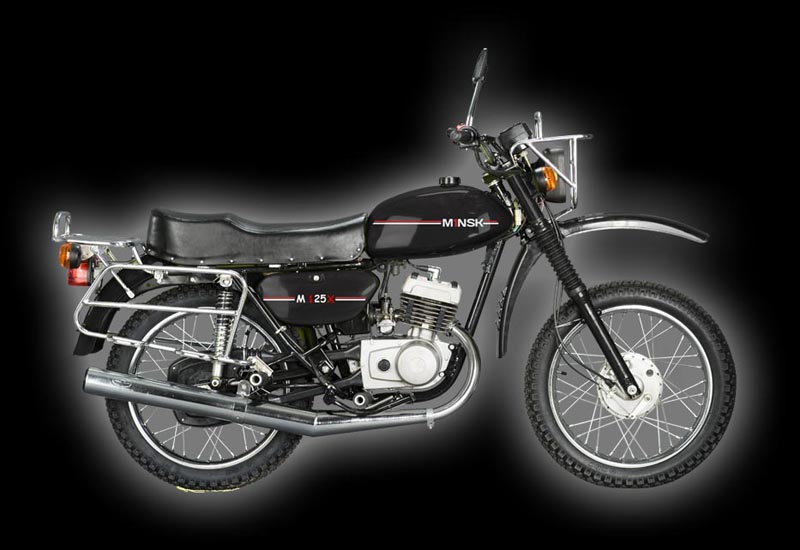
In 2008, the Minsk M 125 was introduced…
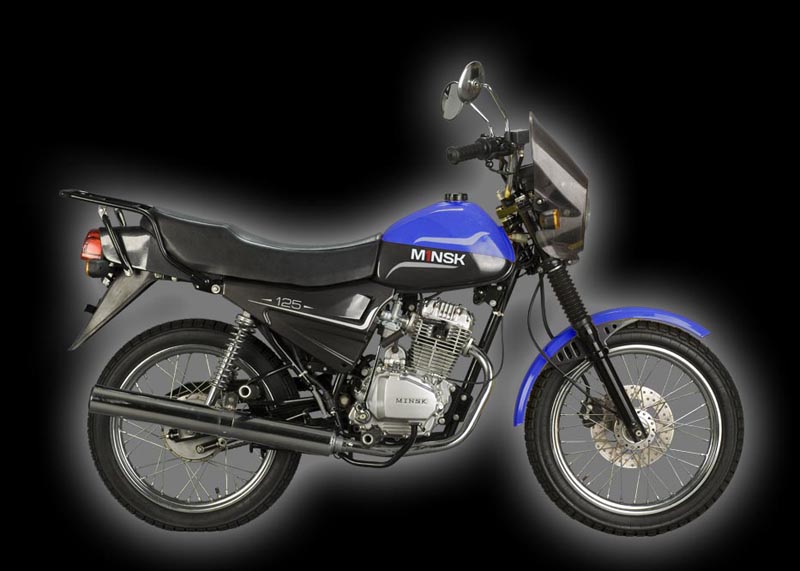
… and its off-road version, the Minsk M 125X. Both 125 models have a single-cylinder two-stroke engine. The top speed is 90 km/h.
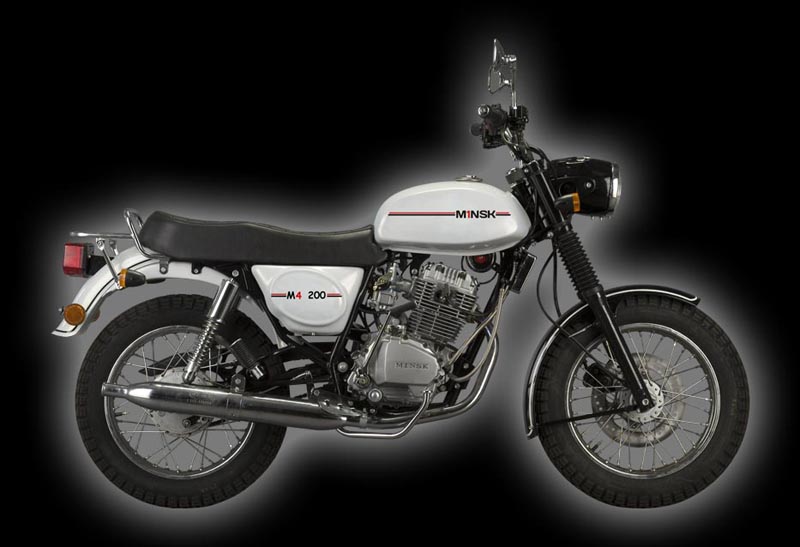
Also dating from 2008 is the Minsk M4 200, with a single-cylinder four-stroke engine of 200 cc, five gears and electric start. Its top speed is 110 km/h.
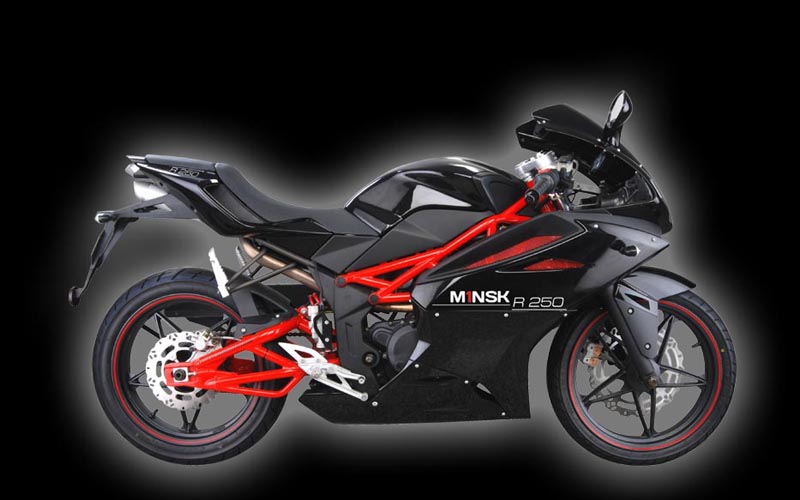
The 2010 Minsk R 250 has a four-stroke engine, 26 hp, 249.5 cc displacement, six gears, and petal-type disc brakes. Its top speed is 145 km/h. Among all Minsk motorcycles, it appears the most modern.
The 2010 Minsk C4 250 has a four-stroke engine, electric start and five gears. Its top speed is 110 km/h.
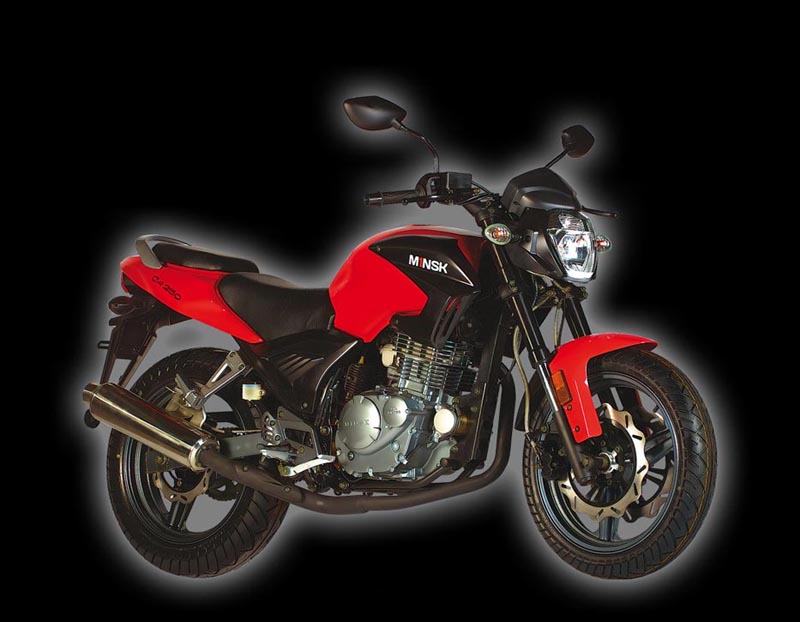
You may have noticed that I have taken all the photographs of the new models from the factory’s official website. Normally I do not do this, because I find it far more interesting to see objects in their real environment of use. However, I have never seen a new-generation Minsk motorcycle—either in real life or on the internet. And I truly cannot imagine who would wish to buy one, or why. In Belarus they know how to make good tractors, but I do not think they have suddenly learned how to make good motorcycles.
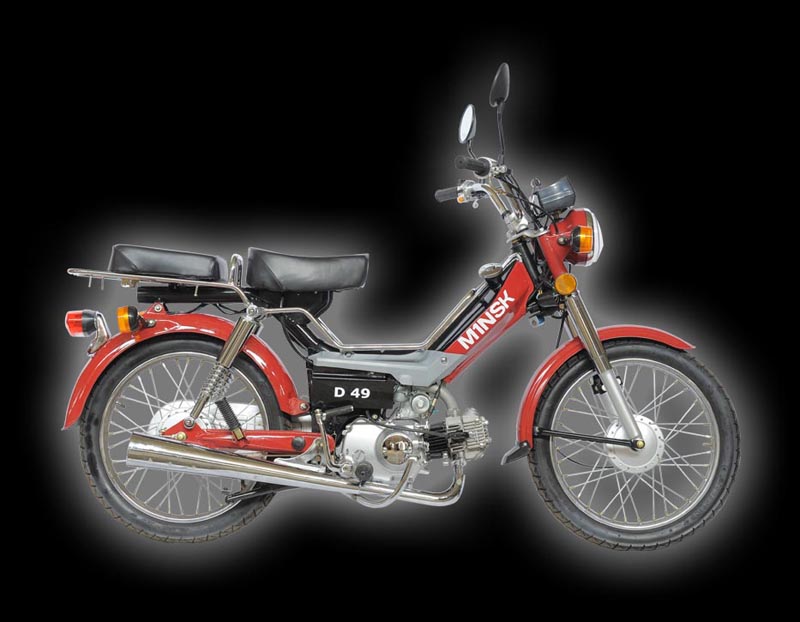
To conclude, let me show you their Minsk D 49 moped. I did not think vehicles of this type were still in production. And yet they are. The D 49 has a four-stroke engine, 2.5 hp and five gears. It weighs 65 kg and reaches a maximum speed of 50 km/h.
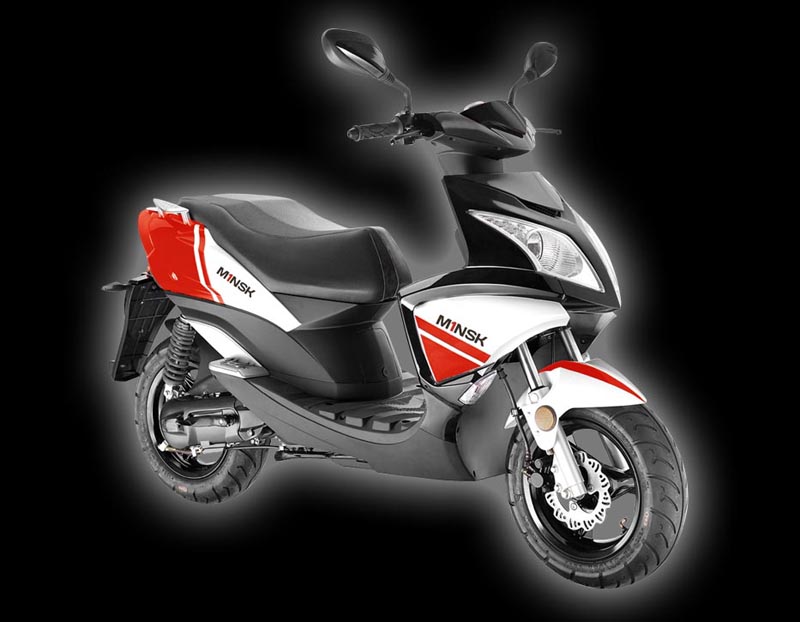
The Minsk TC 49 scooter weighs 87 kg, has a two-stroke engine with 4 hp, and a maximum speed of 45 km/h.
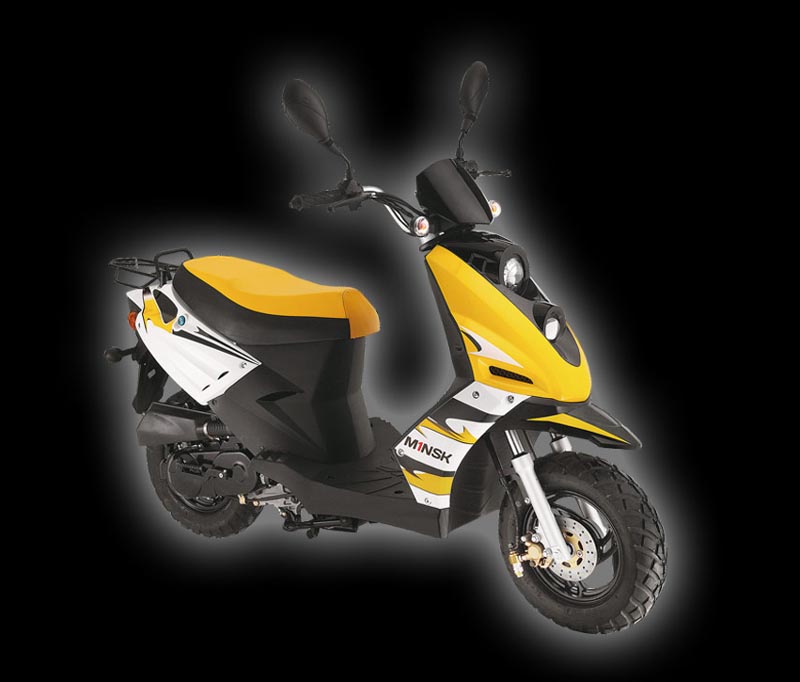
The Minsk TX 49 scooter weighs 81 kg, has a four-stroke engine with 2 hp, and a maximum speed of 45 km/h.
If one day Europe decides to support the economy of the «last dictatorship», you may see many Minsk motorcycles on the roads: they are truly inexpensive.
§3. The “Minsk” Motorcycle
↓ Show comments ↓

