


 Long live Ukraine! Fuck the war!
 RSS of site articles
For the choice of my December travel destinations, I tried to adopt a new principle, dictated solely by my mood at the time. I wanted to combine mountain walks with the exploration of an interesting town. Apart from these two criteria, the choice of Teglio (in the province of Sondrio) should be considered entirely random.
Unfortunately, the weather conditions were not ideal for photographing mountain landscapes. Yet, despite a light mist, it was still possible to admire the toy-like plain below.
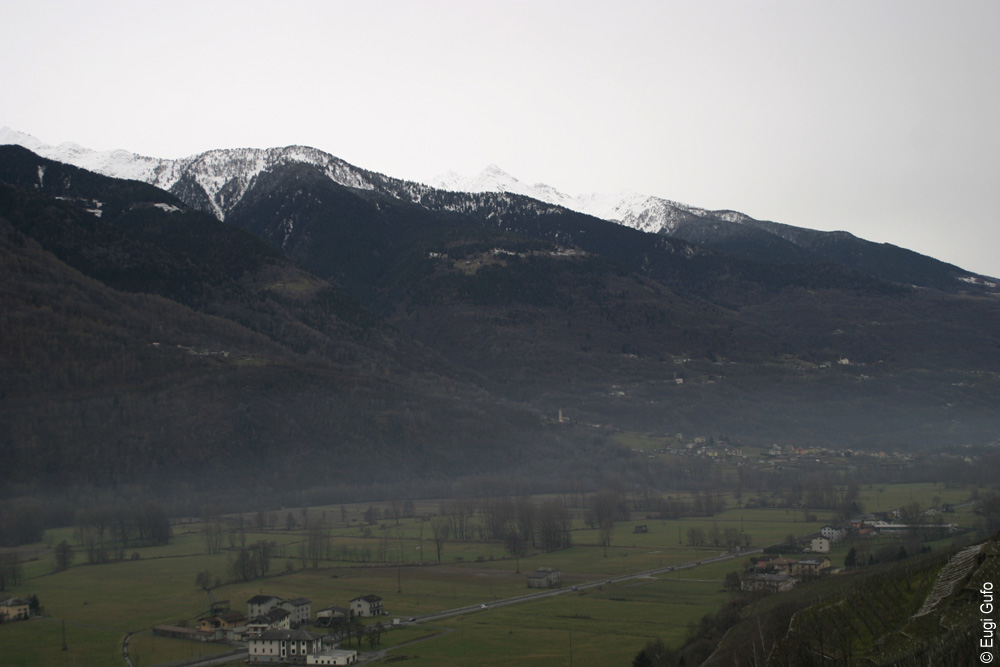
To reach Teglio by public transport, one must get off at the railway station of Tresenda (on the Milan—Tirano line) and then choose between the bus (essentially a very old Mercedes van) or a long, though not particularly gentle, uphill walk. As I have already written, my intention was to walk. From above, one can clearly see that Tresenda is little more than a row of houses stretched along the railway line.

Google claims that the 4.2 kilometres of gentle ascent from Tresenda to Teglio can be completed in 1 hour and 17 minutes. I did not verify the actual distance, but I did discover that, for the first time in my life, Google gave me an incorrect time estimate: I usually take far less time than indicated, whereas this time the opposite happened. Did I take a wrong turning? In any case, during the walk I was able to contemplate several rather curious sights. Here, for example, is a viaduct in reverse: a small river made to pass over the road.

The production building of a local winegrower is connected to the vineyard by a cableway for grapes. I cannot claim this to be a local peculiarity (or invention). I merely note that I saw several other such cableways along the route.

Once I finally arrived in Teglio, I initially thought I had ended up in a rather ordinary winter holiday village.

In reality, however, Teglio has a beautiful and authentic historic centre, with a typically Alpine aesthetic.

For its mere 4,581 official inhabitants, Teglio boasts no fewer than seven churches, some of which are genuinely interesting.

The medieval prison of Teglio — whose dates of construction and operation are not indicated even on the municipal information board — is now privately owned (as is the Executioner’s House opposite). Nevertheless, its façade, preserved in conditions similar to the original ones, makes precisely the right impression: a depressing one. It is worth seeing. The building closely resembles the prisons I imagined as a child while reading medieval novels.

Yet within the municipal territory, right in the heart of the historic centre, there are also other institutions of forced detention. They too are undoubtedly pleasing at least from an aesthetic point of view. Above all, they are still in operation.

Around the village I noticed a relatively large number of small washhouses — often designed for a single user — and not a single large one (of the type to which I have become accustomed in Italian towns). I do not know why they are so numerous, nor why some bear dates from the late twentieth century. Were they still being built because there was not yet a centralised plumbing system in the houses? Or do the dates refer to restorations? The latter option seems somewhat at odds with tradition, however.

The municipal park is not very large, yet it is full of equipment of various kinds for children. A playground in the strict sense of the word.

The contents of garages (and sometimes even of open parking spaces) remind us that we are not on the plain. Even in flat agricultural areas I have never happened to see such things.

The stacks of firewood beside many houses could perhaps also be considered distinguishing features of a mountain area.

What reminds us that we are in a small rural locality are signs such as this one:

Even small towns, however, cannot do without art. This interesting example of street art, for instance, depicts cheerful local horses running each on its own, despite forming part of the same team.

Yet works of art will not deceive us: throughout the village we find numerous signs of the inhabitants’ closer relationship with nature than with urbanisation. One such sign may be the widely used model of benches.

Or the plant pots…

Or the ashtrays…

However, some fashions typical of large cities have also reached Teglio. For example, the trend of using old pallets for outdoor bar furniture.

This fashion has even been extended to public street furniture. In Teglio it is easy to spot benches of this kind:

Many litter bins are likewise disguised with pallets.

Unlike Milan, in Teglio they installed a real Christmas tree even in 2019 (a positive point!), though it is not the only one in the village.

Along the streets, one can in fact see many «silhouettes» of Christmas trees: since they are almost all identical, they must be a decoration devised by the municipality.

I have never seen anything of the sort elsewhere. Nor have I ever encountered installations of this type (which, in my view, are only possible in small localities):

Equally curious is the fact that in Teglio all trees are decorated for Christmas, not only firs.

Even those that appear practically dead:

My visit happened to fall on 24 December, so I was able to witness a local tradition: «Father Christmas’s elves» were roaming around the village, helping him distribute gifts chosen with the assistance of the children’s parents. I do not know why they were already out in the afternoon, nor did I manage to understand who organised their activity. Yet when they shouted the interrogative «A photo?», I promptly responded with a snapshot — ahahaha.

And thus we have seen all the essential features of Teglio. Let us descend once more towards the railway station, contemplating the simple local beauties.

It is just as well that I did not go in summer: the ascent and descent are almost entirely devoid of shaded areas. The sun is one of my worst enemies. Meanwhile, the pace at which I walk long distances is one of the worst enemies of many of my friends. Fortunately, not of all of them.
Teglio, 24 December 2019
↓ Show comments ↓


