


 Long live Ukraine! Fuck the war!
 RSS of site articles
Palazzolo sull’Oglio (province of Brescia), situated halfway between Brescia and Bergamo, is an anomalous — or, if one prefers, fortunate — town. One hundred per cent of its traditional tourist attractions have been meticulously described on Wikipedia. In fairness, the complete inventory can be accommodated within an article of moderate length.
Fortunately, my reports tend to extend beyond the boundaries set by guidebooks, and I do not generally adjust my view of life to match pre-polished facts.
The Torre del Popolo, built between 1813 and 1838, rises to 91 metres and is said to be the tallest round tower in Italy. The people (including the tourist subset) are not permitted to enter it in order to study its interior or contemplate the town from above.
Despite the disappointment, a constructive suggestion presents itself. Italian mayors: promote the construction of triangular towers — even modest ones. Global distinction is a matter of geometry, not height. Aesthetic considerations, as demonstrated here, are secondary.

Another structure readily marketable to tourists is the 4th-century Roman bridge. The tilted horizon in the photographs is not my intervention. The builders simply worked with a limited supply of stone. The result is slightly massive, though some boats still pass beneath it.

A second bridge, entirely different in style and reserved for pedestrians, stands a few dozen metres away. Their proximity produces a mild conceptual dissonance.

Along the riverside in the centre, several old balconies lean gently toward the water — presumably an effect of age. Only recently did I learn that the rounded «bulging» shape of such balconies allowed ladies wearing the voluminous skirts fashionable in the 18th and 19th centuries to approach the railing comfortably.

Direct access points to the water are limited…

… but those that exist are solidly constructed and, in certain cases, enhanced by contemporary artistic additions.

The third bridge in town is modern, yet worthy of attention.

To complete the riverside inventory, one must mention the mooring area for private boats, located almost in the centre. It is organised in a simple but aesthetically satisfying manner and remains unguarded.

The artificial rapids in the river serve a purpose.

They belong to the local hydroelectric plant operated by Italgen S.p.A., which advertises its activity accordingly.

Returning to architecture: the most interesting examples are not civic.

Nor, unexpectedly, are they religious. The 11th-century Porta di Mura — the yellow structure resembling part of an industrial building — is the sole surviving fragment of the medieval defensive walls.

The Rocca Magna (Rocha Magna), built between the 9th and 12th centuries, is not in pristine condition. Its particular charm lies in the impression that a siege concluded only recently: the defenders are gone, but the restoration feels incomplete.
Its underground passages are reportedly still accessible. They were, however, locked and displayed no visiting hours — a familiar national custom.

Inside the fortress stand two period buildings restored with noticeable approximation.

The rocca is inhabited primarily by a small number of unconventional animals.

On the plan of the fortress one can clearly see three of the four towers (on the river side) and, along the curve of the wall, the aforementioned «tallest round tower in Italy.»

Since access to the 91-metre viewpoint has been denied, the visitor must settle for the panorama from the fortress entrance. The structure visible behind the bell tower on the right resembles yet another castle tower.

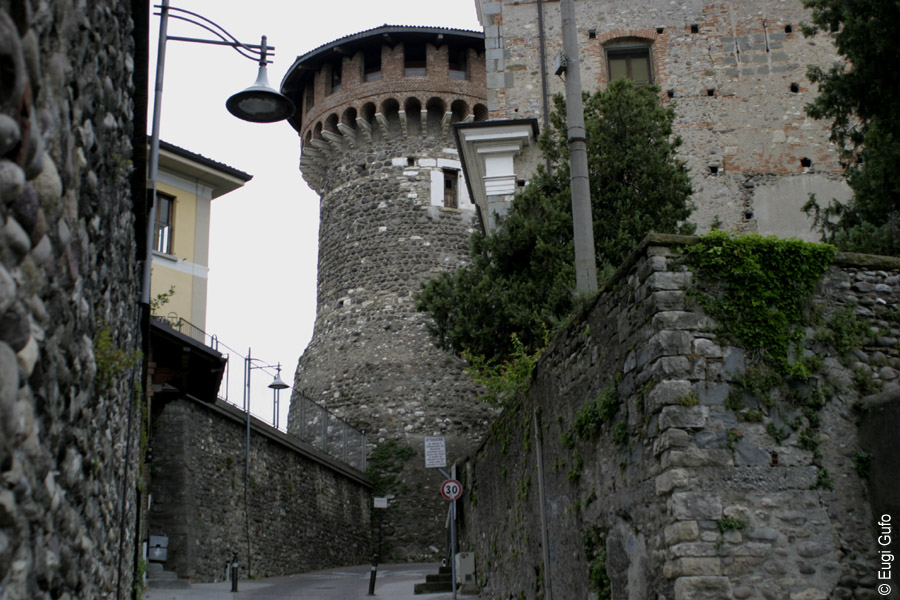
The Round Tower of Mura (25 metres high, 10 wide), built between the 8th and 9th centuries and completed in the 12th, once belonged to a fortified complex controlled by the adversaries of the rocca’s occupants. Its original entrance, according to Wikipedia, stands at a height of 13 metres. Observing the structure, one may reasonably infer that the door exceeds that measurement.
In the early 20th century the tower narrowly avoided demolition. It was instead converted into a water reservoir. Only in the late 1990s was it restored and «opened to the public.» In the local dialect, this expression signifies the installation of a robust metal door at a more human height — firmly locked.
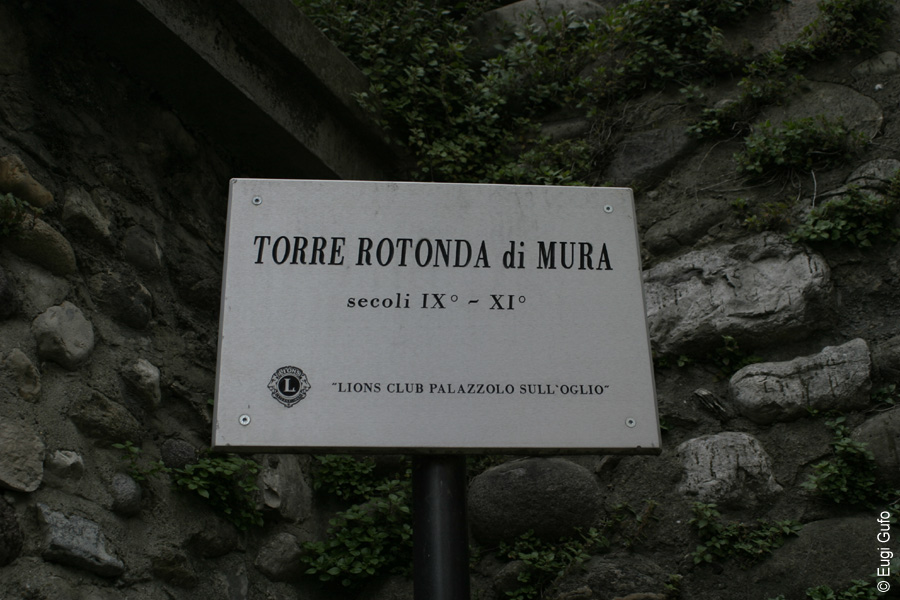
Many historic buildings in Palazzolo are accompanied by metal plaques through which the local Lions Club demonstrates a certain flexibility toward grammatical standards.
The older civil architecture is, overall, limited in interest.

I did not have the opportunity to study most church interiors. The small Chiesetta dei Morti del Russ, however, is modestly compelling in its simplicity.

There are also the «Three Villas.» The most appealing, in my estimation, is the one appearing least Italian. A significant portion of its surrounding land is left to wild grasses and flowers of notable variety. Those wishing to rediscover that flowers possess distinct fragrances should visit in spring or summer. Compared to these, the average florist’s product resembles plastic.

These appear to be the remains of a greenhouse (once elegant) now used for hay storage and miscellaneous objects.

Structures of this type seem to survive only in small towns. They remain useful.

Road signs of this sort are equally practical. The QR-code section, however, raises methodological questions: its function and destination remain unclear.

Older murals are easier to contemplate.

Among modern monuments, the oversized clothespin in the riverside park deserves mention. Other public artworks are distributed throughout the town.

The railway station could plausibly apply for museum status. On the reserve tracks I encountered several remarkable specimens. The railway bicycle has entered my list of aspirations.

Returning briefly to modern art: above one of the streets, paper fish had been suspended in place of the customary umbrellas. The wind produces a pleasant kinetic effect.

Modern art, however, does not always prioritise clarity.

Utility sometimes prevails. A private individual has generously mounted a small lamp on the exterior wall of a residence.

Municipal benches are present only in certain zones and do not pursue aesthetic ambition.

Litter bins vary in model and are frequently equipped with ashtrays. This second feature suggests administrative pragmatism: reducing cigarette debris is a measurable objective.

For the first time, I observed a container for used vegetable oil positioned in the middle of the street as though it were an ordinary bin.

Road renovation, when executed properly, looks like this.

Final outcomes, however, require planning. Near the centre, a narrow stepped pedestrian street unexpectedly transforms into a vehicle-accessible lane. The transition lacks evident necessity.

Certain historic marble street signs are redundantly accompanied by unattractive modern duplicates.

The public fountain in the park is governed by a lengthy and occasionally imaginative regulation. For example, water may not be used for washing cars or for games. The fountain observes operating hours (it rests at night) and a seasonal calendar (March to November). The immediate question concerns enforcement. One is reminded of American municipal ordinances forbidding the walking of crocodiles or the use of another person’s car horn. It appears that matters could be worse.

In summary, Palazzolo sull’Oglio is a town that is both livable and visitable. Should you find yourself with nothing else to do during a segment of your single allotted life, it remains available.
Palazzolo sull’Oglio, 24 April 2017
↓ Show comments ↓


