


 Long live Ukraine! Fuck the war!
 RSS of site articles
Lodi Vecchio bears its name for a reason that some may suspect, though not everyone knows it explicitly: it is the old seat of the city of Lodi. Destroyed several times by the Milanese during local wars, the city was transferred in 1158 by Frederick I, Holy Roman Emperor to a safer location (still strategically important, yet more easily defensible). In the abandoned site, however, a number of risk-tolerant inhabitants remained. Over the centuries, local wars gradually ceased and Lodi Vecchio—despite having been used as a source of building materials for the new city—survived, though never becoming large enough to call itself a city.
On the outskirts and in the centre alike, it always feels like nothing more than a sizeable village.

Beyond the modest scale of its built surface and its typical architecture, the high degree of provinciality is also evident in the organisation of public spaces. Why do provincial towns so adore vast tiled expanses with as little greenery as possible? The peculiarity becomes clearer if we recall that in large cities—farther removed from nature—the opposite tendency has been observable for years. One shrugs.

The main church of the town also faces the Town Hall square. Though ancient, it has remarkably little of interest.

Indeed, the only truly noteworthy detail is technical: the clock on the bell tower is illuminated by a simple low-energy light bulb.

The decidedly more interesting local church (and perhaps glimpsed by many of my readers from the A1 motorway) is the Basilica of San Bassiano. It stands only a few dozen metres from the inhabited centre, yet the road leading to it is not immediately obvious. Do not surrender; seek it out. You will be rewarded.

By some curious optical effect, the basilica appears smaller up close than one expects from a distant view. The interior is simple yet beautiful, decorated with frescoes from the first half of the fourteenth century and several earlier bas-reliefs. I took no photographs only because Mass was about to begin at the time of my arrival.

The town’s principal peculiarity lies in its internal ideological conflict. On the one hand, Lodi Vecchio is nicknamed «the Stalingrad of the Lodigiano» because since 1945 it has consistently been governed by left-wing or centre-left administrations. On the other hand, the town is saturated with religious symbolism. The communists of old would hardly have approved.

The most beautiful secular building in Lodi Vecchio is the eighteenth-century Palazzo Rho, which appears, however, to have been abandoned for years (I am unsure why Wikipedia claims otherwise). In a larger town it would not have been left to decay so quietly.

A modest quantity of antiquity is also present, though reduced far more drastically than the aforementioned palace. Within an area of a few dozen square metres one may see the foundations of a Roman public building, a Roman basilica, and the ancient cathedral built in the fourth century and demolished at the end of the nineteenth. Essentially, these are structures erected one atop the remains of another across successive historical periods. I cannot say anything about the local archaeological museum.

Some eighteenth-century buildings that have survived to the present are currently disused. It appears, however, that they were employed—at least for a time—by local farmers and breeders.

Other buildings from the same era are still used by those entrepreneurs. It is curious to encounter such scenes only a few steps from the centre.

In truth, the outskirts of Lodi Vecchio are by no means uniform. Part of them, as we have just seen, remains agricultural. Another part is characterised by large private villas…

… which occasionally display original architectural flourishes.

And then there is the periphery of anonymous apartment blocks—stylistically depressing and indistinguishable from the outskirts of almost any Italian city.

Lodi Vecchio possesses more than one park, yet all those I saw are constructed in the same fashion: a lawn with a few trees planted here and there. The term «park» is applicable only by virtue of the municipal signage.

Not all local benches may be described as original.

Nor are the litter bins. Their sole peculiarity lies in their diminutive size.

The items of urban furniture that ought to be envied and imitated by almost every Italian city are the ashtrays mounted at regular intervals along the streets. Many administrations, however, seem to prefer that people discard cigarette ends on the ground or set fire to generic bins.

For separate waste collection, residents of private houses have been provided by the Municipality with containers of advanced quality: they even feature reflectors to protect themselves from cars (though I am uncertain with what degree of success).

I have an idea as to what this structure might be, though I obtained no official confirmation. If my hypothesis is correct, it is something admirable, useful, and modern. Why have I never seen one in Milan?

I was about to write that this structure, positioned on the outskirts, would be a shelter for homeless cats… But then I recalled that cats possess their own, rather different, conception of home.

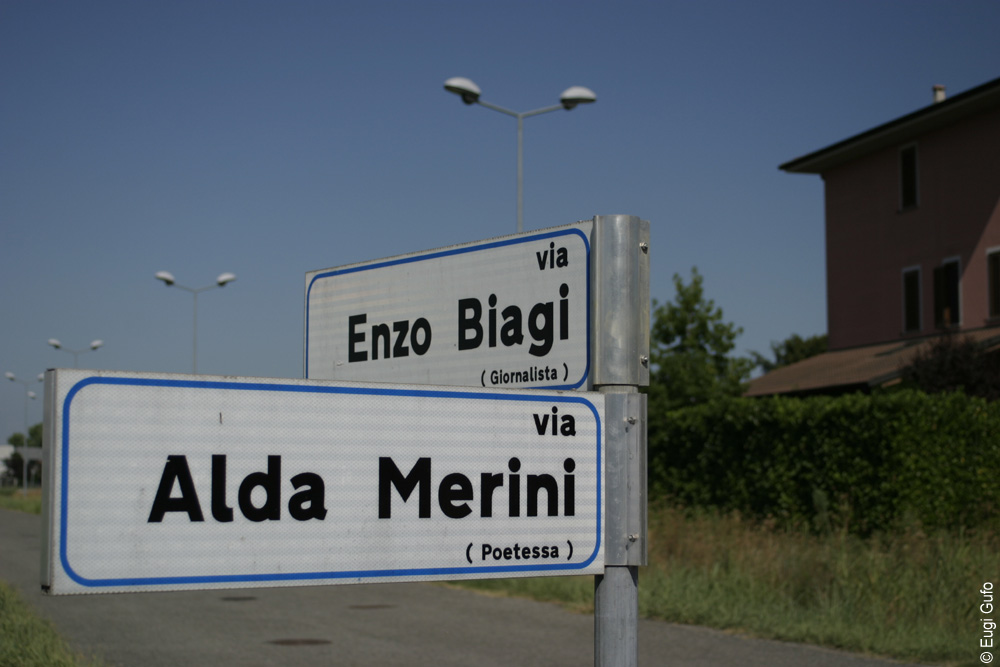
I have never seen these two street names either together or separately.
Likewise for the first time, I encountered such a manner of indicating house numbers.

American-style mailboxes are popular here as well.

Yet rarer models are also present. Being almost flat, they ought to be rather impractical.

And thus, somewhat abruptly, I realised that I have shown you all that is interesting in Lodi Vecchio. I shall return only if some resident—patriot informs me of a genuinely noteworthy aspect that I happened to overlook.
Lodi Vecchio, 27 July 2019
↓ Show comments ↓

