


 Long live Ukraine! Fuck the war!
 RSS of site articles
Arona is a Piedmontese town of just over fourteen thousand inhabitants, separated from the Piedmont—Lombardy border only by the waters of Lake Maggiore. Being reasonably appreciated by tourists thanks, precisely, to the lake, it is not an impoverished locality and is therefore well maintained. As is the case with the majority of small towns of this type, however, Arona does not possess extraordinary man-made wonders or monuments of major historical significance. Consequently, the tourist—ethnographic study of Arona is characterised entirely by the search for small yet interesting details.
In the historic centre one finds several pleasing examples of architecture, well integrated into the physical geography of the place.

In most architectural details one easily notices the primary importance attributed to the lake. In the latter case, this is an economically sensible choice.

The lake and the mountains surrounding the town are beautiful even without human traces.

On certain occasions the presence of the lake is also exploited very effectively by artists. One of Arona’s most curious monuments doubles as a bench. One wonders how many photographers have made use of this combination. For my part, I could not decide whether placing the monument somewhat closer to the water would have been too banal.

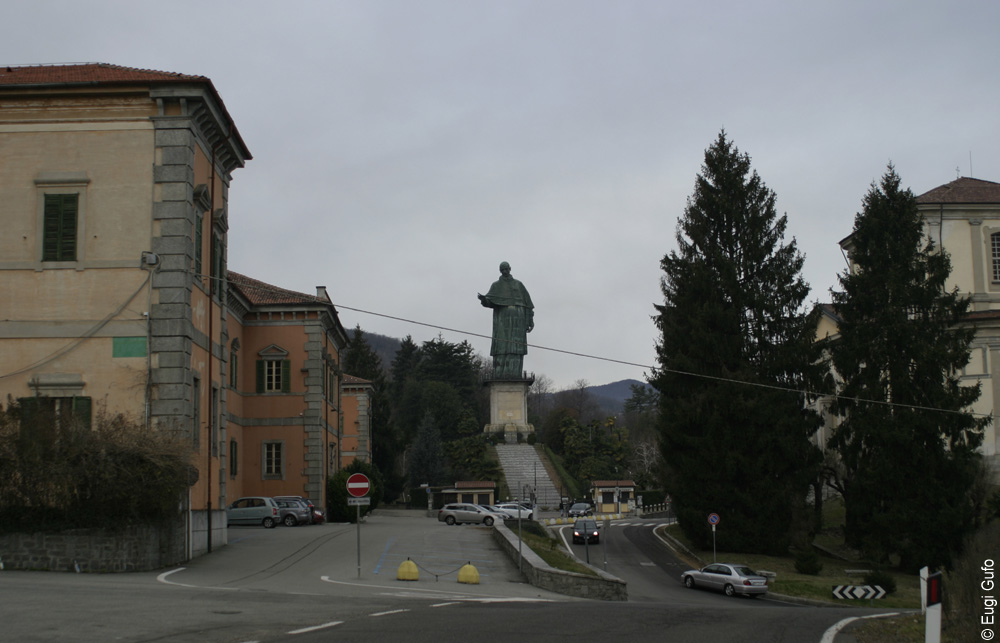
The most publicised monument in Arona is the statue known as the «Colosso di San Carlo Borromeo» (the Sancarlone). At almost 32 metres in height, it was once the tallest statue accessible from within until the construction of the Statue of Liberty. It stands outside the town on the hills and, from a purely artistic perspective, does not justify the walk (unless one wishes to confirm that seventeenth-century Italy, too, produced sculptors with an approximate knowledge of anatomy).
Within the town of Arona, other figures are commemorated. Unfortunately, however, the dimensions of monuments are inversely proportional to their usefulness for the development of the town and the State. The engineer Gian Giacomo Ponti, founder of STIPEL (a telephone company active between 1925 and 1964), has earned only a plaque on his birthplace.

Traces of more ancient history — for instance the foundations of Roman walls — are tended by street sweepers: nothing unusual, given the level of interest such ruins hold for anyone who is not a highly specialised historian.

Very little also remains of the Rocca Borromea of Arona, on whose former territory a park now stands.

Interesting and original secular buildings are often found in courtyards and secondary streets. In such places one encounters real daily life, rather than the tourist version.

One may even observe architectural elements that have become exceedingly rare and about which no guidebook will inform you: bathrooms added to ancient buildings that once lacked them.

Even the traditional «casa a ringhiera» can be beautiful. I am almost sorry that one of the few examples I found in Arona is in a state of abandonment.

Another example appears still inhabited and retains its old glass panes, preserved — in my view — by miracle. Fortunately, the residents do not oppose miracles.

The Municipality of Arona, meanwhile, has its own conception of beauty. Well, considering Italian traditions in this field, these Christmas lights appear not excessively banal.

A truly alarming conception of beauty, however, resides in the minds of certain local shopkeepers. Thus, for example, a beautiful woman would consist of a pair of legs and something undefined that sparkles immediately above them.

In 2016 I had already encountered in Calolziocorte a travel agency with a fine and original name. The attractive name of an agency in Arona, by contrast, sounds more like a stern truth than an elegant joke. Travel changes the mind — I cannot deny it.

A workshop specialising in the repair of sewing machines has five shop windows filled with old machines produced by various factories around the world. Should its primary activity cease to be profitable, it could easily be transformed into a splendid technical museum. I would certainly visit — especially if one were permitted to try using the models that arouse my curiosity.

Some shopkeepers in the centre have united in a form of class struggle.

A local pro loco association has also produced a curious sign. Yet instead of «video-surveilling» lit cigarettes in permitted areas, it ought to address the cigarette butts that end up on the ground. The incapable prefer easy challenges.

Old ceramic street plaques are unfortunately rare. But they do exist.

On one single occasion I saw a street name indicated in a genuinely original manner. On a dark, non-uniform wall it is barely visible — I noticed it almost by chance. Nevertheless, its presence is preferable to the Italian tradition of writing street names once every two or three kilometres.

To some (though inexplicably not all) low-cost signs, metal strips have been added bearing information about the persons commemorated. Who forbade writing everything in the originally designated space? They are structures I have never encountered before.

For the first time I also saw the expression «Area Demaniale» on a sign. What purpose does this specification serve? Was it added so that people do not complain to the Municipality about the quality of maintenance? I remain uncertain.

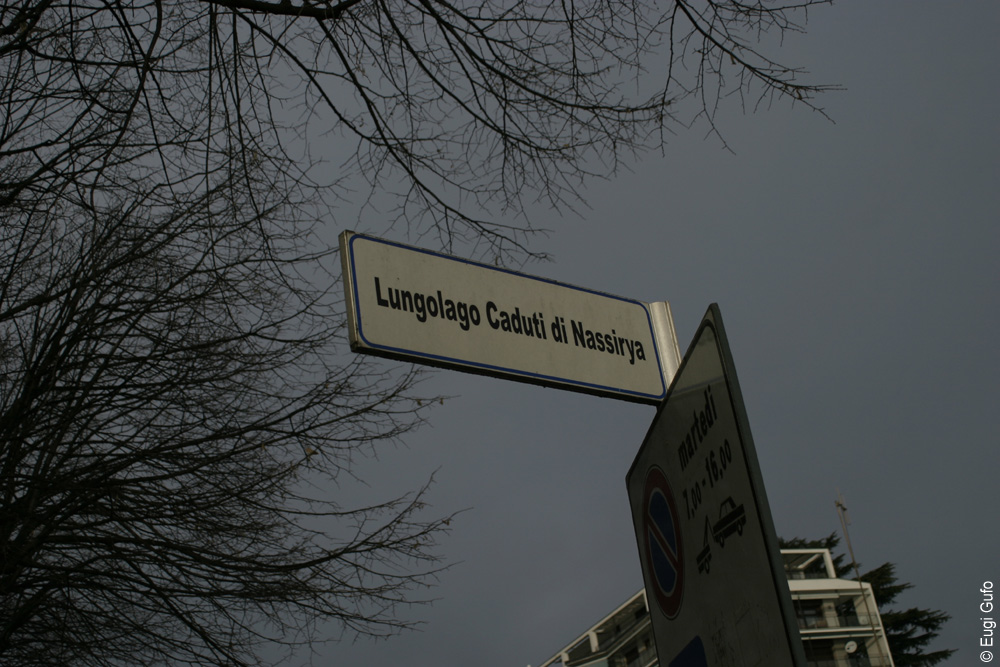
A section of the lakeside promenade is dedicated to a recent war event — another rarity in Italy.
Along the lakeside I also encountered a bench model both elegant and previously unknown to me.

Many litter bins have been fitted with ashtrays of brutal yet functional design.

On a peripheral stretch of the lakeside, benches alternate with interesting exercise equipment, much appreciated by the elderly.

For their grandchildren there are play structures that combine intellectual and physical components. I was immediately reminded of my first physical education teacher (a veteran of the war in Afghanistan), who frequently devised competitions involving mathematical exercises. One had to run across the gymnasium, solve a problem, and run back; the winning team was determined by the best combination of time and correct calculations.

An interesting model of drinking fountain.

Another sociologically interesting aspect of Arona concerns the organisation of separate waste collection. Each housing unit is provided with differently coloured containers for each category of material to be displayed on designated days. In general, however, this is an aspect of Italian daily life that I have so far studied only superficially.

Returning to somewhat loftier matters, let us recall that Arona hosts a landing stage of Navigazione Lago Maggiore. In essence, it is a small harbour.

The railway station, by contrast, is of anomalous size: the building has three storeys (instead of the customary two) and at first glance resembles an institutional palace.

While waiting for my train to Milan, I noticed the presence of an instrument I had never before seen in old Italian stations: a period lift. I believe that these lifts, present on every platform, are approximately as old as the station itself (opened in 1905) and were originally intended for moving goods and luggage (observe their wide, horizontal openings). It would be pleasing to see them revived and adapted for passenger use (lifts for persons with reduced mobility must exist in any case).

At this point, having examined all the interesting details I managed to discover, let us leave Arona to its customary life and set off homewards.

Arona, 22 December 2018
↓ Show comments ↓

