


 Long live Ukraine! Fuck the war!
 RSS of site articles
I had to go there in person to discover that, from a tourist’s point of view, Garlasco (province of Pavia) is a town without a clear purpose. Architecture of genuine historical interest is scarce — and what little there is tends to be slightly peculiar.

Religious architecture, as is customary in Italian towns, stands at a reasonably respectable level.

The local Cathedral, whose façade does not particularly strive for originality, proves more interesting inside thanks to the rich variety of natural stone patterns…

… and a carefully assembled nativity scene (someone even went as far as creating a lake with a mirror)…

… and the statue of a «saint» of fairly recent production accompanied by a photograph of Teresio Olivelli (feel free to consult the rather unusual Wikipedia article about this distinctive figure).

My exploration of the Cathedral interior acquired an oddly surreal flavour due to the worst kind of pop music — played at a volume normally associated with nightclubs — coming from the adjacent square. Who was responsible? The operators of this ice-skating rink.

In addition to the aforementioned rink, the square between the Town Hall and the Cathedral also hosted a Christmas tree. Are you still dissatisfied with the one installed in your own city?

It is said that Garlasco enjoys popularity among religious tourists thanks to the nearby Sanctuary of the Madonna della Bozzola. I shall limit myself to saying that it is not bad, although for me the most beautiful religious structure in the Pavia area remains the Certosa di Pavia.

Ordinary tourists, on the other hand, might be tempted by rumours of the existence of the «castle» of Garlasco. In reality, however, only a single tower remains — restored in a manner that could be described as mildly vandalistic.

As for the inner area of the former castle, I would never have identified it as such had I not read the brown-background sign politely informing me that a 14th-century castle once stood there.

Staying with martial themes, one should acknowledge the merit of the monument to the Resistance fighters: at least it avoids the usual pseudo-heroic sculptural rhetoric.

At this point I ought to say something about the town’s civil architecture (at least in the historic centre), but the only noteworthy detail consists of windows painted onto the façade of an old building.

Judging by certain traces observed on some walls, there must have been a period in Garlasco’s history when street names were written directly onto houses using a stencil.

Today, by contrast, extremely low-cost plaques are widespread.

Fortunately, private companies are present to place their graphic advertisements in the most appropriate locations.

The true artists of Garlasco, however, are those responsible for the road markings: zigzag pedestrian crossings appear in remarkable abundance (and in various interpretations).

Cycle lanes are widespread in the historic centre. Their positive aspect is that they align with the carriageway rather than the pedestrian pavement filled with defenceless citizens; their negative aspect is the near-total absence of physical protection from motor traffic. In fairness, almost all cyclists in Garlasco conscientiously attempt to remain within their designated lanes. My apologies to the cyclist who struggled to avoid me while I was photographing from the middle of the red strip.

At last, some agreeable pinwheels.

Garlasco also boasts its own original bin design. This specimen goes straight into my photographic collection.

Another model — equally exclusive to Garlasco — is somewhat less common.

And that is almost everything of interest. What remains is the small railway station which, in this fog, becomes a physical representation of hope. The hope of suddenly seeing a train appear — one capable of taking us away from this place.

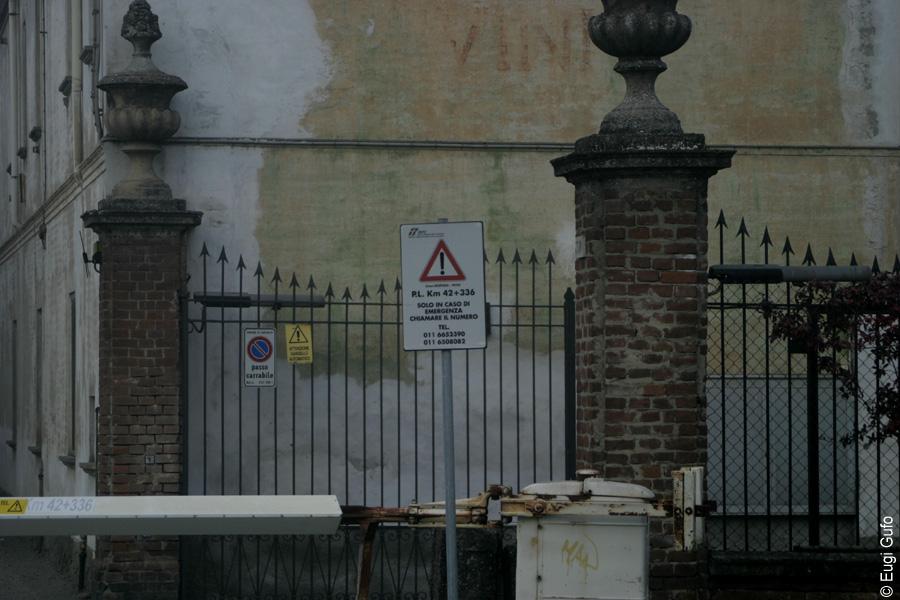
Shortly before departure, the gentleman visible in the first station photograph pointed out a curious detail. Although Garlasco has always been Lombard, the level crossing very close to the station is managed by an authority based in Turin. «But we pay our taxes in Lombardy.»
If I have accidentally managed to make you fall in love with Garlasco, do consider purchasing this detached 100-square-metre house for €50,000.

P.S. Asia! I am quite certain that in a few years’ time they will be fighting over your right to drink as much, wherever, and whenever you please.
Garlasco, 9 December 2016
↓ Show comments ↓

