


 Long live Ukraine! Fuck the war!
 RSS of site articles
The name of the town of Magenta naturally evokes, in the mind of anyone minimally educated, the battle of 1859. It was precisely this association that led me into a minor logical trap: I constructed the equation «site of a well-known historical event = historically interesting place to visit.» Historical sites, as is widely accepted, tend to possess at least some degree of interest. Consequently, on 7 December 2015, eager to enrich my cultural background, I travelled to Magenta.
It did not initially strike me as suspicious that I had never heard or read anything else — either about its past or its present.
In a park near Magenta railway station stands the Ossuary of the famous battle. I was unable to discover its interior, as the doors were, at the time of my visit, firmly locked and secured.

A few dozen metres away stands the monument to Mac Mahon, depicted in a posture that might generously be described as lacking heroic conviction. Perhaps he was indeed so inclined in real life; nevertheless, monuments to military heroes are traditionally conceived somewhat differently.

Throughout the town one encounters informational panels such as this. One might conclude that the battle of 156 years ago constitutes the primary justification for Magenta’s continued existence.

In reality, another local asset is promoted with equal determination: near almost every church one finds stands dedicated to the town’s saint. That her beatification followed circumstances that left her daughter motherless does not appear to complicate matters. Civic utility, it seems, prevails.

Magenta’s largest church — the Basilica of San Martino — is unquestionably worth visiting.

Certain elements of its façade deserve examination no less attentive than that afforded to parts of Milan Cathedral.

The town’s other religious buildings, however, do not significantly trouble the architectural memory.

The road leading towards the historic centre is not especially compelling, though it offers the explorer a reasonable hope that something more engaging may follow.

Wandering in search of architectural distinction, a careful observer may discover several characteristic old courtyards…

…as well as buildings of varying age maintained in conditions proportionate — or not — to their historical value.

This, meanwhile, appears to be a former petrol station. I suspect it dates from the 1950s, perhaps earlier, though I may be mistaken. In any case, it stands as a monument of considerable historical consequence.

On the subject of cars: I finally encountered, in person, an urban parking space reserved for pregnant women. Until now I had seen such signage only in shopping centre car parks.

On the subject of future children: at first glance, the machine in the following photograph appeared to be an automated pharmacy. «How convenient,» I thought, «to purchase medicines at night without searching for an open chemist.» The reality proved more prosaic: it is merely a condom vending machine, discreetly lacking the usual identifying features.

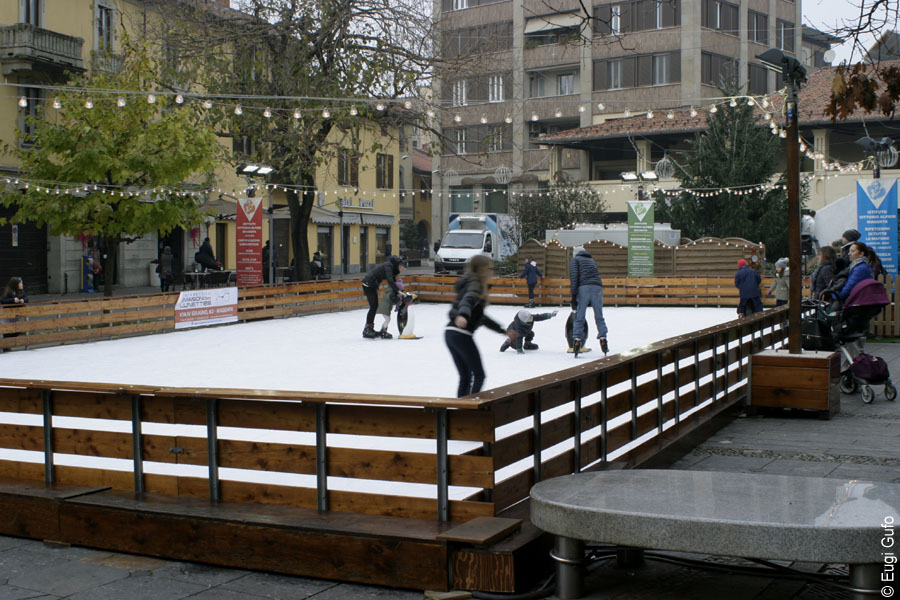
Children already born may enjoy themselves in winter on a small skating rink. In the lower right corner one may observe a bench in polished granite — apparently a local speciality.
More conventional benches appear in a variety of models, though almost always attractive. Some bear resemblance to those in Treviglio.

Large plant containers are concentrated almost exclusively in the vicinity of the aforementioned basilica. Their limited number is not necessarily problematic; what matters is that traditionally planted trees remain present. Parks, at least, are not in short supply.

Magenta’s bike-sharing scheme resembles that of numerous other Italian towns (Chiari, Lodi and Ravenna among them). Private bicycle parking, however, allows the frame — and not merely a wheel — to be secured, which suggests a commendable degree of practical foresight.

The most common litter bins in the historic centre are unexpectedly unattractive.

Elsewhere in town, two alternative models prevail. The one decorated with diamond shapes is new to me and will be added to my personal collection.

The Fountain of Life:

Speaking of water: the manhole covers of the aqueduct are rectangular and executed in an antique style. They are, simply, pleasing.

If you are wondering why I have ceased describing Magenta’s more conventional attractions, the explanation is straightforward: there are no further examples to report. Having resigned myself to the absence of the beauties traditionally associated with a historic centre, I settled instead for smaller details — an irregularly shaped shop sign…

…a marble plaque with unexpectedly elegant lettering…

…and street art through which younger residents attempt to render their town marginally less melancholic.

Printed newspapers attached to a stand with clothespins represent a form of urban installation that is gradually disappearing from European cities. Let us preserve the memory.

There is little reason to exert ourselves in preserving overly vivid memories of this visit, which proves modest from a touristic perspective. Let us proceed towards more promising destinations and take the train. Magenta’s railway station is relatively attractive — considerably above the Lombard average — yet possesses one notable peculiarity: it lacks any departure boards displaying train times. Advance planning, or mobile internet, is therefore advisable.

In the year 2115, historians of ethnographic photography and two-dimensional lomography may convene at an interdisciplinary conference to address the enduring question: «Why did Eugi Gufo go to Magenta?» I hope they meet with greater analytical success than I did.

