


 Long live Ukraine! Fuck the war!
 RSS of site articles
At the end of the unlucky visit to Certosa di Pavia, I had planned to devote the rest of the day to exploring the city of Pavia.

After all, the train takes just 7 minutes. Pavia railway station is identical to the one in Lodi; the only minor differences are the colour and the absence of the hideous cornice.

But 30 April 2012 seemed determined to become a day of misfortune at all costs: it was raining in Pavia. So I took only a quick walk and snapped a few photos while hiding under various arcades, awnings, etc.
Taking advantage of the following photo, let me remind you that everyone who installs air-conditioning units on the façades of historic buildings will burn in hell.

The centre of Pavia is beautiful: absolutely worth visiting. Even in non-central areas, interesting buildings often pop up.

What struck me in particular was the number of churches that have not been restored and are in poor condition. My astonishment reached its peak when I saw this mix of a church, a block of flats and a factory:

Some monuments look as if they were made to be displayed in a kitsch living room rather than out in the street.

The monument dedicated to the famous university has a very serious appearance.

The covered bridge over the river Ticino is an almost identical copy of the bridge built in the 14th century and destroyed after the Second World War. I think it is well known to everyone: today it is one of the city’s symbols.

The marketing-obsessed idiots have infiltrated the municipal offices of Pavia as well: having a beautiful bridge in the city is not enough for them. They also want proof that a famous man used to count Pavia’s bridges during bouts of insomnia.

Fortunately, there are also people in the city who understand the importance of restoration work: I saw many construction sites. The workers do not even leave their workplaces for lunch.

The usual concrete blocks that restrict car access are often decorated with spheres that make them look like plastic ice creams: it is rare to see something so disgusting.

In general, one can say that Pavia does not lack concrete: they can afford massive installations of this kind.

But accelerated cementification is diabolically reconciled with environmental protection. Pavia has its own car-sharing system.

And also bike sharing, with racks similar to those seen in Brescia.

In busy peripheral streets, cycle paths are protected by low concrete walls.

Urban bus stops are attractive.

The sign listing the flags of the mysterious people authorised to park for free reminds me of The Napoleon of Notting Hill by Chesterton (read it!).

Pavia’s litter bins do not have a dominant style. I liked the large ones, even if they are not particularly original.

Among the smaller bins, however, I would highlight those in the historic centre.

Shopkeepers in Pavia, like those in Vigevano, do not want people sitting under their shop windows.

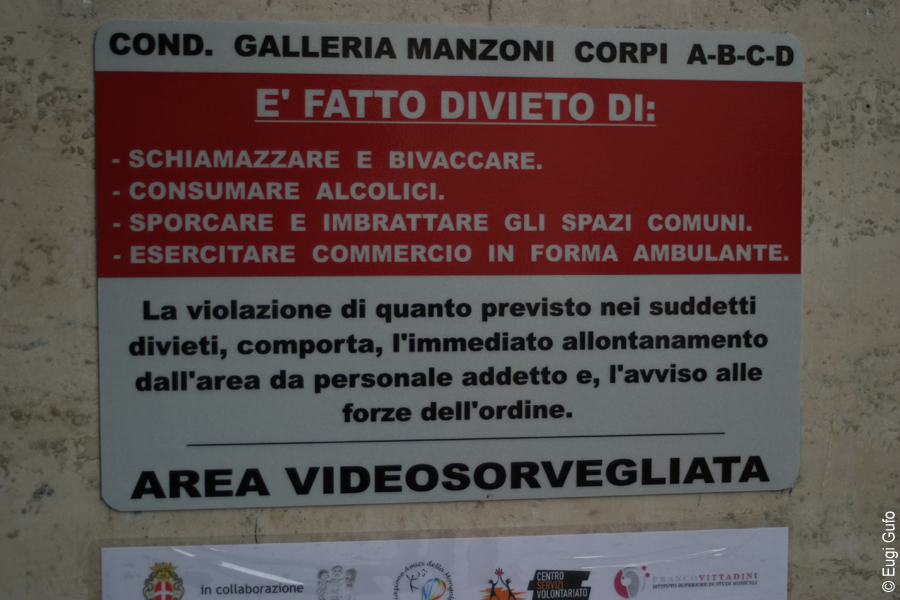
On the walls of many buildings, if one looks carefully, it is possible to notice small signs with content and/or purposes that are often inexplicable.


According to Pavia grammar, in notices, commas, are, placed, at, random.
That’s all for now. I promise to return to Pavia on a sunny day so that I can fully appreciate all its beauties.
Pavia, 30 April 2012
↓ Show comments ↓

